
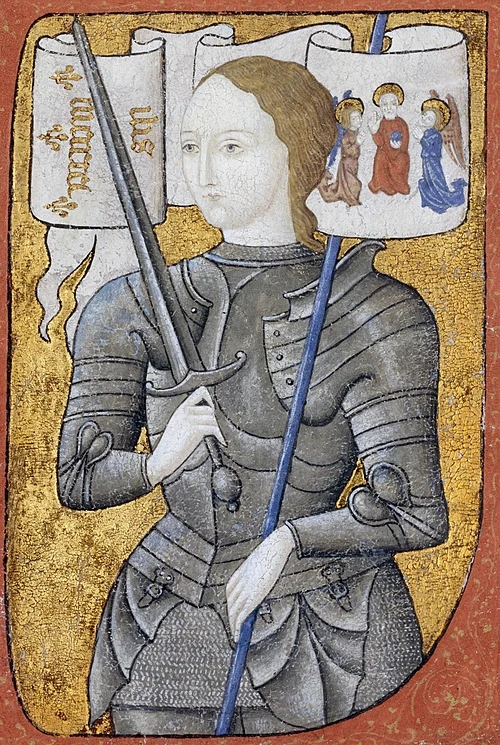
Jeanne d'Arc
Also known as: The Maid of Orléans · La Pucelle d'Orléans · Jehanne la Pucelle
Military Leader - National Heroine of France - Catholic Saint
Map
Timeline
Born in Domrémy
Born to a peasant farming family in the village of Domrémy in northeastern France, during the heart of the Hundred Years' War.
First Visions
Around age thirteen, she began hearing voices she identified as St. Michael, St. Catherine, and St. Margaret, urging her to support Charles VII.
Meets the Dauphin at Chinon
Travelled to Chinon and convinced the future King Charles VII to grant her command of a relief army, reportedly identifying him disguised among courtiers.
Lifts the Siege of Orléans
Led French forces to break the English siege of Orléans in just nine days, a turning point that transformed the war's momentum.
Coronation of Charles VII
Escorted Charles VII to Reims Cathedral for his coronation, fulfilling the mission her voices had assigned and legitimizing the French crown.
Battle of Patay
French forces crushed the English field army at Patay, largely destroying English power in northern France and cementing Joan's reputation.
Siege of Orléans
Orléans, France - vs English forces under Talbot and Scales - Breaking the five-month siege transformed the war's momentum and made Joan famous across France overnight.
Battle of Jargeau
Jargeau, France - vs English forces under the Earl of Suffolk - Cleared English garrisons from the Loire valley and captured the Earl of Suffolk.
Battle of Patay
Patay, France - vs English forces under Talbot and Fastolf - Destroyed the English field army; Lord Talbot was captured, reversing English dominance in northern France.
Captured at Compiègne
Captured by Burgundian forces during a skirmish outside Compiègne and sold to the English for 10,000 livres.
Battle of Compiègne
Compiègne, France - vs Burgundian forces under John of Luxembourg - Joan was captured here; her capture led directly to her trial and execution in Rouen.
Burned at the Stake in Rouen
Condemned for heresy and cross-dressing by a Church court operating in English interests; executed in Rouen's market square at age nineteen.
Posthumous Rehabilitation
A retrial ordered by Pope Callixtus III declared her innocent, annulled the original verdict, and proclaimed her a martyr.
Family Tree
Parents
Jacques d'Arc
Father
c. 1380-1440
Isabelle Romée
Mother
c. 1385-1458
Subject & Siblings
Joan of Arc
Self
c. 1412 - 1431
Jacquemin d'Arc
Brother
Jean d'Arc
Brother
Pierre d'Arc
Brother
Key Contributions
-
Shield Siege of Orléans
Broke the English siege of Orléans in nine days, reversing the course of the Hundred Years' War and saving the French monarchy.
-
Crown Coronation of Charles VII
Ensured the coronation of Charles VII at Reims, legitimizing the French royal line at its most vulnerable moment.
-
Eye Visions and Divine Mission
Claimed divine guidance from saints, making her one of history's most celebrated mystic military commanders.
-
Star Catholic Canonization
Canonized by Pope Benedict XV in 1920, she is the patron saint of France and an enduring symbol of national identity.
Fun Facts
Sword
Wore Full Plate Armor
Joan wore custom-made white plate armor in battle, becoming immediately recognizable on the battlefield despite being a teenager.
Zap
Shot by an Arrow and Returned to Fight
At the siege of Orléans, Joan was struck by an arrow above her breast. She pulled it out, prayed briefly, and returned to lead the assault the same day.
FileText
Dictated Letters to the English
Joan dictated several letters to English commanders demanding they abandon France, signing them boldly "Jehanne la Pucelle" — Joan the Maid.
Execution by burning — conviction of heresy and cross-dressing
Location
Location: Old Market Square (Place du Vieux-Marché), Rouen, Normandy
Burial: Seine River, Rouen, France
Those Present
-
Pierre Cauchon
Bishop who presided over the heresy trial on behalf of English political interests.
Impact
Joan's execution shocked many in France and across Europe. The English hoped to discredit Charles VII by association, but the effect was the opposite. French forces rallied, and within two decades the English were expelled from most of France, concluding the Hundred Years' War. Joan became the defining symbol of French national identity for all subsequent centuries.
See Also
Other Figures
Related Sites
"I am not afraid. I was born to do this."
Attributed, from her trial records, 1431