
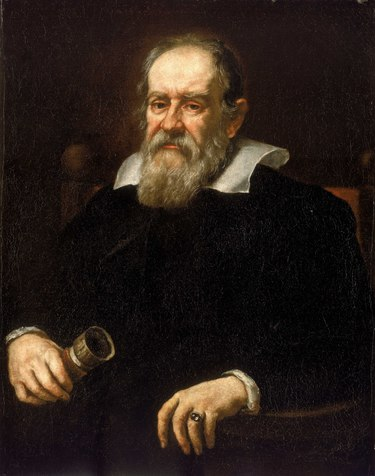
Galileo Galilei
Also known as: Galileo · The Father of Modern Science · The Father of Observational Astronomy
Astronomer - Physicist - Father of Modern Science
Map
Timeline
Born in Pisa
Born on February 15 to Vincenzo Galilei, a lutenist and music theorist, in Pisa, Tuscany.
Professor at Pisa
Appointed Professor of Mathematics at the University of Pisa and conducted early experiments on falling bodies, challenging Aristotle.
Moves to Padua
Appointed to the prestigious chair of mathematics at the University of Padua, where he spent 18 of his most productive years.
Improves the Telescope
Learned of the Dutch spyglass and quickly improved it to 20× magnification, the first to turn one systematically to the sky.
Starry Messenger Published
Published Sidereus Nuncius, announcing the discovery of four moons orbiting Jupiter — the first bodies observed orbiting something other than Earth.
Letters on Sunspots
Published observations of sunspots, contradicting the Aristotelian belief in the perfection of the heavens.
Warning from the Inquisition
Summoned to Rome and warned by Cardinal Bellarmine not to hold or defend the Copernican heliocentric view.
Dialogue Concerning Two World Systems
Published his masterwork comparing the Ptolemaic and Copernican models; the Church saw it as defying the 1616 injunction.
Trial by the Inquisition
Found "vehemently suspect of heresy" by the Roman Inquisition; forced to recant and condemned to life imprisonment, later commuted to house arrest.
Two New Sciences Published
Smuggled his final masterwork on kinematics and material strength out to the Dutch Republic; it became the foundation of classical mechanics.
Dies at Arcetri
Died on January 8 at his villa in Arcetri, having spent his last four years completely blind and under house arrest.
Family Tree
Parents
Vincenzo Galilei
Father
1520-1591
Giulia Ammannati
Mother
1538-1620
Subject & Siblings
Galileo
Self
1564 - 1642
Marina Gamba
Partner
1570-1612
Spouses
Virginia (Sister Maria Celeste)
Daughter
1600-1634
Livia (Sister Arcangela)
Daughter
1601-1659
Vincenzo Galilei
Son
1606-1649
Key Contributions
-
Eye Telescopic Astronomy
First to systematically observe the sky with a telescope, discovering Jupiter's moons, lunar craters, sunspots, and the phases of Venus.
-
Zap Laws of Falling Bodies
Proved that all objects fall at the same rate regardless of mass, demolishing 2,000 years of Aristotelian physics.
-
Microscope Scientific Method
Championed empirical observation and mathematical analysis as the basis of natural philosophy, founding the modern scientific method.
-
AlertTriangle Conflict with the Church
His trial by the Inquisition for defending heliocentrism became the defining historical moment in the conflict between science and religious authority.
Fun Facts
Clock
Discovered the Pendulum's Law
As a young man, Galileo noticed that a swinging chandelier always took the same time to complete its arc regardless of the arc's width — the isochronism of the pendulum.
EyeOff
Went Completely Blind
Galileo went totally blind in 1638, four years before his death, likely from retinal damage and glaucoma — possibly aggravated by years of solar observation through his telescope.
Music
Gifted Lutenist
Galileo was an accomplished musician, having inherited his father Vincenzo's skill on the lute and reportedly preferring music to mathematics in his youth.
Natural causes — fever and heart palpitations following years of house arrest and blindness
Location
Location: Villa Il Gioiello, Arcetri, Grand Duchy of Tuscany
Burial: Basilica di Santa Croce, Florence, Italy
Those Present
-
Vincenzo Galilei
Son who cared for Galileo through his final years of house arrest and blindness.
Impact
Galileo died condemned by the Church, but his ideas were already spreading across Europe. Isaac Newton, born that same year, would build his laws of motion and universal gravitation directly on Galileo's work. The Catholic Church formally acknowledged in 1992 that it had erred in condemning Galileo.
See Also
Other Figures
"All truths are easy to understand once they are discovered; the point is to discover them."
Attributed to Galileo Galilei