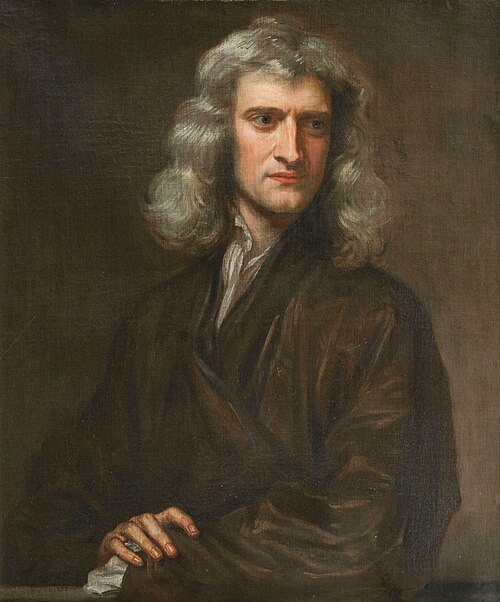
Isaac Newton
Also known as: Sir Isaac Newton · Father of Classical Mechanics
Mathematician - Physicist - Astronomer - Natural Philosopher
Map
Timeline
Born in Woolsthorpe
Born prematurely on Christmas Day (Julian calendar) in Woolsthorpe Manor, Lincolnshire, three months after the death of his father.
Entered Cambridge University
Enrolled at Trinity College, Cambridge, initially as a subsizar — working as a servant to pay his fees.
Annus Mirabilis
During a plague closure of Cambridge, Newton returned home and developed his theories on calculus, optics, and gravity — including the legendary apple incident.
Invented the Reflecting Telescope
Built the first practical reflecting telescope, using a curved mirror instead of a lens to eliminate chromatic aberration.
Theory of Light and Colour
Presented his discovery that white light is composed of a spectrum of colours to the Royal Society, founding the science of modern optics.
Principia Mathematica Published
Published Philosophiæ Naturalis Principia Mathematica, establishing the three laws of motion and the law of universal gravitation — the foundation of classical physics.
Master of the Royal Mint
Appointed Warden, then Master of the Royal Mint in London, where he oversaw a major recoinage and vigorously prosecuted counterfeiters.
President of the Royal Society
Elected President of the Royal Society, a position he held until his death in 1727.
Knighted by Queen Anne
Became the second scientist ever to be knighted, receiving the honour from Queen Anne at Trinity College, Cambridge.
Death in London
Died on 20 March in Kensington, London, aged 84. He was buried with great ceremony in Westminster Abbey.
Family Tree
Parents
Isaac Newton Sr.
Father
1606–1642
Hannah Ayscough
Mother
1623–1679
Barnabas Smith
Stepfather
1582–1653
Subject & Siblings
Newton
Self
1643 - 1727
Children
Catherine Barton
Niece (lived with Newton)
1679–1739
Key Contributions
-
Apple Law of Universal Gravitation
Formulated the law that every mass attracts every other mass with a force proportional to their masses and inversely proportional to the square of their distance.
-
Zap Three Laws of Motion
Newton's laws of motion form the foundation of classical mechanics, describing how objects behave under force — still used in engineering and physics today.
-
Calculator Invention of Calculus
Independently developed calculus (fluxions), the mathematical framework for understanding change and motion, simultaneously with Leibniz.
-
Sun Optics and Light
Demonstrated that white light is a mixture of all colours of the spectrum using a prism, and built the first reflecting telescope.
Fun Facts
Apple
The Apple Story
Newton reportedly watched an apple fall from a tree at Woolsthorpe Manor, which inspired his thinking about gravity. The story was told by Newton himself in old age, though likely simplified.
Eye
Stuck a Needle in His Eye
To study the nature of light and colour perception, Newton inserted a bodkin (blunt needle) between his eye socket and eyeball — and somehow retained his sight.
Cat
Invented the Cat Flap
Newton is credited with cutting a large hole and a smaller hole in his door for his cat and her kittens — an early version of the pet flap.
Bible
Secret Theologian
Newton secretly wrote over a million words on theology and biblical prophecy — far more than he wrote on science — and believed he had been chosen by God to decode the Bible.
Kidney stones and inflammation of the bladder
Location
Location: Kensington, London, England
Burial: Westminster Abbey, London, England
Key Figures
-
Catherine Barton
Niece who cared for Newton in his final years in London.
Impact
Newton died as the most celebrated scientist in Europe, having transformed humanity's understanding of the physical world. His death prompted tributes from across the continent. Voltaire's visit to England partly inspired by Newton's state funeral helped spread Newtonian ideas throughout French Enlightenment thought.
See Also
Other Figures
"If I have seen further, it is by standing on the shoulders of giants."
Letter to Robert Hooke, February 1675