
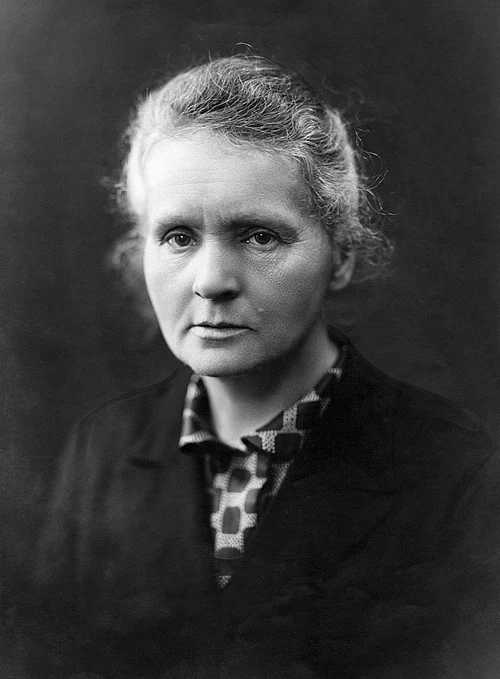
Marie Skłodowska Curie
Also known as: Marie Curie · Madame Curie · Maria Skłodowska
Physicist - Chemist - Pioneer of Radioactivity Research
Map
Timeline
Born in Warsaw
Born Maria Salomea Skłodowska on November 7 in Warsaw, then part of the Russian Empire. She was the youngest of five children.
Moved to Paris
Left Warsaw for Paris to study at the Sorbonne, one of the few universities in Europe that admitted women. She lived in poverty in a garret near the university.
Degree in Physics
Graduated first in her physics degree at the Sorbonne — the first woman ever to do so at the institution.
Married Pierre Curie
Married fellow physicist Pierre Curie, beginning one of science's most celebrated partnerships. She took French citizenship but kept her Polish identity.
Discovery of Polonium and Radium
Announced the discovery of two new elements — polonium (named after her homeland) and radium — after years of painstaking work processing tonnes of pitchblende ore.
First Nobel Prize — Physics
Awarded the Nobel Prize in Physics jointly with Pierre Curie and Henri Becquerel for their research on radiation. The first woman to win a Nobel Prize.
Death of Pierre Curie
Pierre was killed by a horse-drawn wagon in Paris. Marie took over his professorship at the Sorbonne, becoming the first female professor in the university's history.
Second Nobel Prize — Chemistry
Awarded the Nobel Prize in Chemistry for the discovery of radium and polonium and the isolation of radium. The first and still only person to win Nobel Prizes in two sciences.
Curie Institute Founded
Founded the Radium Institute (now the Curie Institute) in Paris, which became a world-leading centre for nuclear physics and cancer research.
Petites Curies — Mobile X-Ray Units
During World War I, developed mobile radiography units — nicknamed "petites Curies" — that brought X-ray equipment to the front lines, imaging over a million wounded soldiers.
Death in Sancellemoz
Died on July 4 from aplastic anaemia caused by decades of radiation exposure. She carried test tubes of radioactive isotopes in her pockets and stored them in her desk.
Family Tree
Parents
Władysław Skłodowski
Father
1832–1902
Bronisława Skłodowska
Mother
1836–1878
Subject & Siblings
Marie Curie
Self
1867 - 1934
Spouses
Pierre Curie
Husband
1859–1906
Children
Irène Joliot-Curie
Daughter
1897–1956
Ève Curie
Daughter
1904–2007
Key Contributions
-
Atom Discovery of Radioactivity
Coined the term "radioactivity" and proved it was an atomic property of matter, not a chemical reaction — overturning 19th-century physics.
-
Flask Discovery of Polonium & Radium
Discovered two new elements through years of grinding and processing tonnes of uranium ore by hand in a leaking shed, often working in sub-zero temperatures.
-
Award Double Nobel Laureate
The only person in history to win Nobel Prizes in two different sciences — Physics (1903) and Chemistry (1911) — a record that still stands today.
-
Heart World War I Medical Innovation
Personally drove mobile X-ray units to battlefield hospitals, bringing life-saving diagnostic technology to the front lines for the first time.
Fun Facts
Notebook
Her Notebooks Are Still Radioactive
Marie Curie's personal notebooks are so contaminated with radioactive material that they are stored in lead-lined boxes in Paris. Researchers must sign a waiver and wear protective gear to view them.
Globe
Named an Element After Her Homeland
She named her first discovered element polonium after Poland — then occupied and erased from the world map — as a deliberate act of patriotic defiance against Russian rule.
Award
Refused to Patent Radium
Despite living in near-poverty for years, Marie and Pierre deliberately refused to patent the radium isolation process, believing scientific knowledge should belong to humanity.
Car
Drove Herself to the Front Lines
During WWI, Marie personally drove X-ray vans to battlefield hospitals — having taught herself to drive and repair engines from scratch at age 46.
Aplastic anaemia caused by long-term radiation exposure
Location
Location: Sancellemoz Sanatorium, Haute-Savoie, France
Burial: Panthéon, Paris, France
Key Figures
-
Irène Joliot-Curie
Daughter and fellow Nobel laureate who was present during Marie's final weeks.
Impact
Marie Curie died as a direct result of the work that made her famous. She had spent decades handling radioactive materials without protection, carrying isotopes in her pockets and storing them in her desk. Her death was a stark reminder of the invisible dangers of the atomic age she had helped create. She was 66.
See Also
Other Figures
Related Events
Related Sites
"Nothing in life is to be feared, it is only to be understood. Now is the time to understand more, so that we may fear less."
Attributed, widely cited in science education contexts