
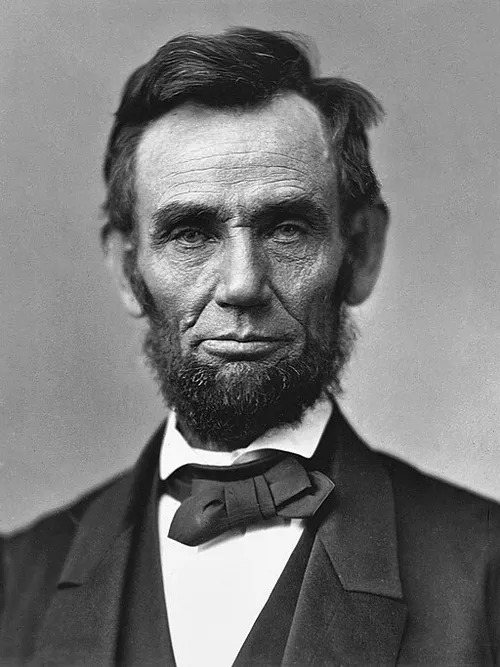
Abraham Lincoln
Also known as: Honest Abe · The Great Emancipator · The Rail-Splitter · Father Abraham
16th President of the United States - Lawyer - Statesman
Map
Timeline
Born in Kentucky
Born on February 12 in a one-room log cabin in Hardin County, Kentucky. His family was poor frontier farmers who moved frequently in search of better land.
Moved to Illinois
Helped his family move to Illinois, then struck out on his own at 21, settling eventually in New Salem — a small village on the Sangamon River.
Black Hawk War & First Election
Volunteered and was elected captain of his militia company during the Black Hawk War. Also ran for the Illinois state legislature for the first time, finishing eighth out of thirteen candidates.
Admitted to the Bar
Licensed to practice law in Illinois after years of self-study, reading law books borrowed from other lawyers. Moved to Springfield the following year to begin his legal career.
Married Mary Todd
Married Mary Todd in Springfield after a turbulent courtship. They would have four sons, only one of whom — Robert — survived to adulthood.
Elected to Congress
Served a single term in the U.S. House of Representatives, where he vocally opposed the Mexican-American War and drew attention to President Polk's justifications for it.
Lincoln-Douglas Debates
Challenged incumbent Senator Stephen Douglas to a series of seven landmark debates across Illinois on the issue of slavery's expansion, bringing Lincoln to national attention.
Elected President
Won the presidential election on November 6, becoming the first Republican president. His election triggered the secession of Southern states and the formation of the Confederacy.
Civil War Begins
Confederate forces attacked Fort Sumter on April 12, beginning the Civil War. Lincoln called for 75,000 volunteers and began assembling the Union war effort.
Battle of Fort Sumter
Charleston, South Carolina - vs Confederate States of America - The Confederate attack on Fort Sumter began the Civil War. Lincoln's response — calling for 75,000 volunteers — unified the North and set the Union war machine in motion.
Battle of Antietam
Sharpsburg, Maryland - vs Confederate Army of Northern Virginia - The bloodiest single day in American military history. The Union's tactical victory gave Lincoln the political moment he needed to issue the Emancipation Proclamation.
Emancipation Proclamation
Issued the Emancipation Proclamation on January 1, declaring enslaved people in Confederate states to be free — transforming the Civil War into a war to end slavery.
Gettysburg Address
Delivered the Gettysburg Address on November 19 at the dedication of the Soldiers' National Cemetery — 272 words that redefined the purpose of the Civil War and American democracy.
Battle of Gettysburg
Gettysburg, Pennsylvania - vs Confederate Army of Northern Virginia under General Lee - The decisive turning point of the Civil War. The Union victory ended Lee's invasion of the North and crippled the Confederate offensive capability permanently.
Re-elected President
Won re-election against Democrat George McClellan in November, with a campaign centred on finishing the war and ending slavery permanently via constitutional amendment.
Battle of Atlanta
Atlanta, Georgia - vs Confederate Army of Tennessee - Sherman's capture of Atlanta in September 1864 revived Northern morale and secured Lincoln's re-election, ensuring the war would be fought to complete victory.
Civil War Ends
Confederate General Robert E. Lee surrendered to Ulysses S. Grant at Appomattox Court House on April 9, 1865, effectively ending the Civil War after four years of fighting.
Assassinated at Ford's Theatre
Shot by Confederate sympathiser John Wilkes Booth at Ford's Theatre in Washington D.C. on April 14. He died the following morning, becoming the first U.S. president to be assassinated.
Appomattox Campaign
Appomattox Court House, Virginia - vs Confederate General Robert E. Lee - Lee's surrender to Grant effectively ended the Civil War, vindicating Lincoln's refusal to negotiate a peace that would have preserved slavery.
Family Tree
Parents
Thomas Lincoln
Father
1778–1851
Nancy Hanks Lincoln
Mother
1784–1818
Sarah Bush Johnston Lincoln
Stepmother
1788–1869
Subject & Siblings
Lincoln
Self
1809 - 1865
Spouses
Mary Todd Lincoln
Wife
1818–1882
Children
Robert Todd Lincoln
Son
1843–1926
Edward Baker Lincoln
Son
1846–1850
William Wallace Lincoln
Son
1850–1862
Thomas "Tad" Lincoln
Son
1853–1871
Key Contributions
-
Scale Abolition of Slavery
Issued the Emancipation Proclamation in 1863 and championed the 13th Amendment, which permanently abolished slavery throughout the United States.
-
Shield Preserving the Union
Led the United States through its greatest internal crisis, refusing to let the nation dissolve and emerging victorious after four years of the bloodiest war in American history.
-
Scroll Gettysburg Address
Delivered one of the most celebrated speeches in history, reframing the Civil War as a struggle for human equality and redefining the meaning of American democracy.
-
Gavel Self-Made Lawyer & Statesman
Rose from frontier poverty and no formal schooling to become a skilled trial lawyer and the most consequential American president, almost entirely through self-education.
Fun Facts
Hat
Used His Hat as a Filing Cabinet
Lincoln famously stored letters, bills, and important documents inside his tall stovepipe hat, using it as a portable office filing system throughout his legal and political career.
Trophy
Nearly Undefeated Wrestler
Lincoln was an exceptional wrestler in his youth, with only one loss recorded in roughly 300 matches. He was inducted into the National Wrestling Hall of Fame in 1992.
Lightbulb
The Only President to Hold a Patent
Lincoln patented a device in 1849 to lift boats over shallow waters using adjustable buoyant air chambers — the only U.S. president ever to hold a patent. The device was never manufactured.
Moon
Dreamed of His Own Death
Lincoln reportedly told his cabinet that shortly before his assassination he had a recurring dream of sailing rapidly toward a "dark and indefinite shore" — a dream he had before every major Civil War event.
Gunshot wound to the head
Location
Location: Petersen House, Washington D.C.
Burial: Oak Ridge Cemetery, Springfield, Illinois
Those Present
-
John Wilkes Booth
Confederate sympathiser who shot Lincoln as part of a wider conspiracy to decapitate the Union government.
Impact
Lincoln's assassination came just five days after the effective end of the Civil War — a moment of national triumph turned instantly to grief. He was the first U.S. president to be assassinated. His death galvanised public support for Reconstruction but removed the one man whose political skill and temperament might have made it succeed.
See Also
Other Figures
Related Events
"Give me six hours to chop down a tree and I will spend the first four sharpening the axe."
Attributed