
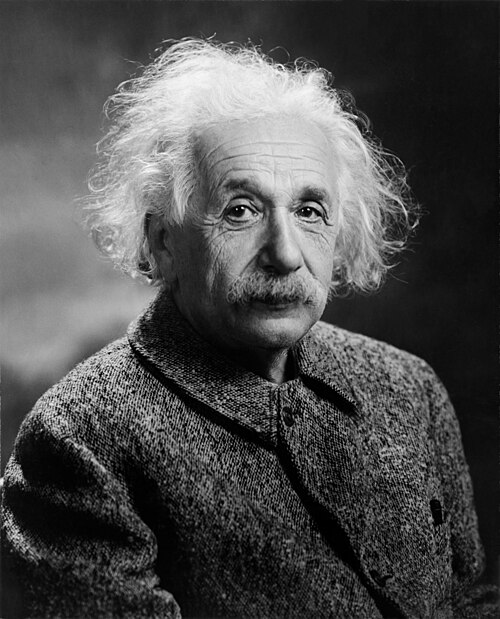
Albert Einstein
Also known as: Einstein · The Father of Modern Physics · The Genius of the Century
Theoretical Physicist - Nobel Laureate - Humanitarian
Map
Timeline
Born in Ulm
Born on March 14 in Ulm, in the Kingdom of Württemberg in the German Empire.
Annus Mirabilis
Published four groundbreaking papers — on the photoelectric effect, Brownian motion, special relativity, and mass–energy equivalence — transforming modern physics.
General Theory of Relativity
Published his general theory of relativity, describing gravity as the curvature of spacetime caused by mass and energy.
Eclipse Confirmation
Arthur Eddington's observation of light bending around the sun during a solar eclipse confirmed general relativity, making Einstein a global celebrity overnight.
Nobel Prize in Physics
Awarded the Nobel Prize in Physics for his discovery of the law of the photoelectric effect, a pivotal step in the development of quantum theory.
Fled Nazi Germany
As the Nazi party rose to power, Einstein, who was Jewish, emigrated to the United States and joined the Institute for Advanced Study in Princeton.
Einstein–Szilard Letter
Co-signed a letter to President Franklin D. Roosevelt warning of the possibility of atomic weapons, helping to initiate the Manhattan Project.
Death in Princeton
Died on April 18 in Princeton, New Jersey, aged 76, from an aortic aneurysm. He refused surgery, saying "I want to go when I want."
Family Tree
Parents
Hermann Einstein
Father
1847–1902
Pauline Koch
Mother
1858–1920
Subject & Siblings
Einstein
Self
1879 - 1955
Spouses
Mileva Marić
Wife I
1875–1948
Elsa Löwenthal
Wife II
1876–1936
Children
Hans Albert Einstein
Son
1904–1973
Eduard Einstein
Son
1910–1965
Key Contributions
-
Atom Theory of Relativity
Special and general relativity revolutionized the understanding of space, time, and gravity, replacing Newtonian mechanics at cosmological scales.
-
Zap E = mc²
The mass–energy equivalence equation demonstrated that mass and energy are interchangeable, underpinning nuclear energy and modern particle physics.
-
Sun Photoelectric Effect
His explanation of the photoelectric effect, for which he won the Nobel Prize, laid the foundation for quantum mechanics and the development of solar cells.
-
Globe Pacifism & Humanitarianism
A lifelong pacifist and civil rights advocate, Einstein spoke out against nationalism, racism, and nuclear proliferation throughout his life.
Fun Facts
Brain
His Brain Was Stolen
When Einstein died in 1955, pathologist Thomas Harvey removed and kept his brain without permission from his family, leading to decades of scientific study.
Violin
Passionate Violinist
Einstein played the violin throughout his life and said that if he had not been a physicist, he would have been a musician. Mozart was his favorite composer.
Socks
Never Wore Socks
Einstein famously avoided wearing socks, considering them an unnecessary complication. He reportedly wrote about this to his cousin Elsa.
Compass
Sparked by a Compass
Einstein credited his lifelong fascination with physics to a compass his father showed him at age five — he was mystified that an invisible force could move the needle.
Rupture of an abdominal aortic aneurysm
Location
Location: Princeton Hospital, Princeton, New Jersey
Burial: Princeton, New Jersey, USA
Key Figures
-
Hans Albert Einstein
Son who was present at his father's death in Princeton.
Impact
Einstein died as he had lived — on his own terms. His death marked the end of an era in physics, though his theories continue to be tested and confirmed to this day. He remains the most recognized scientist in history and a global symbol of intellectual curiosity and moral courage.
See Also
Other Figures
Related Events
"Imagination is more important than knowledge."
Interview in The Saturday Evening Post, 1929