
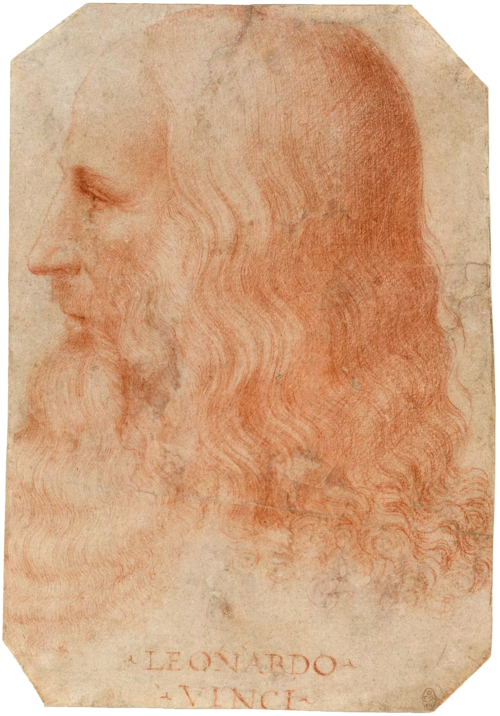
Leonardo di ser Piero da Vinci
Also known as: Leonardo · The Renaissance Man · Il Divino
Painter - Sculptor - Architect - Engineer - Scientist - Inventor
Map
Timeline
Born in Vinci
Born on April 15 as the illegitimate son of a Florentine notary, Ser Piero da Vinci, and a peasant woman named Caterina, in the hill town of Vinci, Tuscany.
Apprenticed to Verrocchio
Moved to Florence and entered the workshop of Andrea del Verrocchio, one of the leading artists of the day, where he trained alongside Botticelli and Perugino.
Admitted to the Painters' Guild
Enrolled in the Guild of Saint Luke in Florence, officially becoming a master painter at just 20 years old.
First Independent Commission
Received his first independent commission — an altarpiece for the Chapel of San Bernardo in the Palazzo della Signoria — beginning his career as an independent artist.
Moved to Milan
Entered the service of Ludovico Sforza, Duke of Milan, offering his skills as an engineer, military architect, and artist. He would remain in Milan for nearly 17 years.
Vitruvian Man
Drew the iconic Vitruvian Man — a study of human proportions based on the writings of the Roman architect Vitruvius — combining art, anatomy, and mathematics.
The Last Supper Begun
Began painting The Last Supper on the wall of the refectory of Santa Maria delle Grazie in Milan, completing it around 1498. It became one of the most reproduced paintings in history.
Mona Lisa Begun
Began work on the Mona Lisa in Florence, widely considered the most famous painting in the world. He is believed to have worked on it for four years.
Anatomical Studies
Conducted systematic dissections of human corpses in Florence and Milan, producing over 240 anatomical drawings of unprecedented accuracy — centuries ahead of published medical science.
Invited to France by King Francis I
Accepted an invitation from King Francis I of France to live at the Château du Clos Lucé near Amboise, spending his final years as the king's premier painter, engineer, and architect.
Death at Amboise
Died on May 2 at the Château du Clos Lucé, aged 67. According to Vasari, he died in the arms of King Francis I, though historians debate this detail.
Family Tree
Parents
Ser Piero da Vinci
Father
1426–1504
Caterina di Meo Lippi
Mother
c.1436–1494
Albiera di Giovanni Amadori
Stepmother I
1436–1464
Subject & Siblings
Leonardo da Vinci
Self
1452 - 1519
Children
Francesco Melzi
Student & Heir
1491–1570
Gian Giacomo Caprotti (Salaì)
Apprentice & Companion
1480–1524
Key Contributions
-
Palette Mona Lisa & The Last Supper
Painted two of the most famous works in human history — the Mona Lisa and The Last Supper — both of which transformed the art of portraiture and composition.
-
Microscope Anatomical Discoveries
Conducted detailed dissections of over 30 human corpses, producing anatomical drawings that were not surpassed in accuracy for over 300 years.
-
Cog Visionary Inventions
Filled notebooks with designs for flying machines, tanks, solar power, adding machines, and double-hull ships — most centuries before they were independently reinvented.
-
Feather Master of Many Arts
Excelled simultaneously as a painter, sculptor, architect, musician, mathematician, engineer, geologist, botanist, and writer — the definitive Renaissance man.
Fun Facts
FlipHorizontal
Wrote in Mirror Script
Leonardo wrote almost exclusively in mirror script — right to left, only readable in a mirror. He was left-handed, but whether this drove the habit or it was deliberate secrecy is still debated.
Palette
The Mona Lisa Has No Eyebrows
The Mona Lisa originally had eyebrows and eyelashes, but high-resolution scans have shown they faded over time due to overcleaning. They were there when Leonardo painted her.
Wind
Obsessed with Flight
Leonardo filled pages with designs for flying machines, including an ornithopter and a hang glider, having spent years observing birds in flight. He is believed to have tested some designs himself.
Skull
Dissected 30 Corpses
Leonardo secretly dissected over 30 human and animal corpses — an activity that was legally and morally dangerous at the time — to understand anatomy from the inside out.
Suspected stroke
Location
Location: Château du Clos Lucé, Amboise, France
Burial: Chapel of Saint-Hubert, Château d'Amboise, France
Key Figures
-
Francesco Melzi
Devoted pupil who inherited Leonardo's notebooks and preserved them until his own death in 1570.
Impact
Leonardo died having left most of his greatest projects unfinished — the equestrian statue for Milan, the Battle of Anghiari fresco, the Trivulzio monument. Yet the work he did complete changed art, science, and human ambition permanently. His notebooks, rediscovered gradually over centuries, continue to yield new insights today.
See Also
Other Figures
"Learning never exhausts the mind."
Attributed, from Leonardo's notebooks