
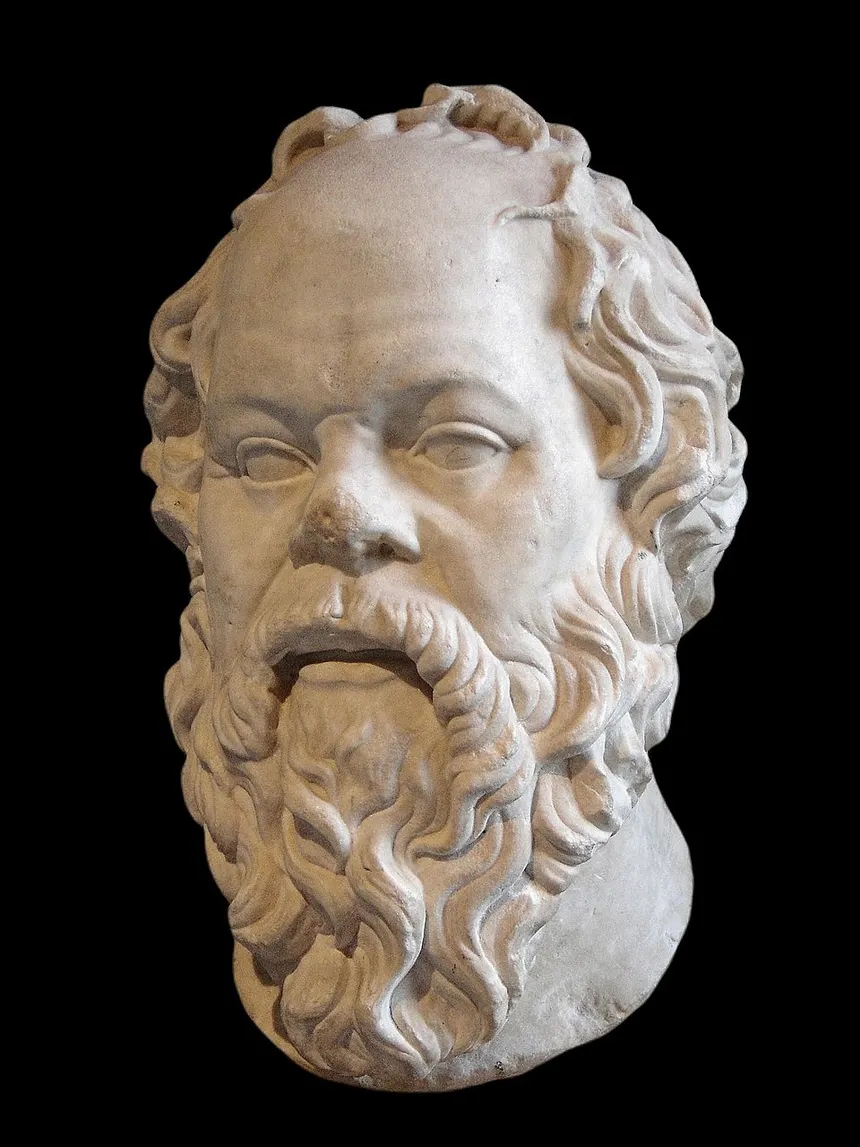
Socrates
Also known as: Socrates of Athens
Philosopher - Teacher - Founder of Western Philosophy
Map
Timeline
Born in Athens
Born to Sophroniscus, a stonemason, and Phaenarete, a midwife, in the deme of Alopece near Athens.
Early Career as Stonemason
Worked as a stonemason in his youth, reportedly carving statues of the Graces, before turning entirely to philosophy.
Military Service at Potidaea
Served as a hoplite in the Athenian army at the siege of Potidaea, earning praise for extraordinary endurance and bravery.
Battle of Delium
Fought at the disastrous Athenian defeat at Delium; Plato records that Socrates' cool, unhurried retreat drew the admiration of observers on both sides.
Mocked in Aristophanes' Clouds
Featured as a comic character in Aristophanes' play The Clouds, which contributed to his public image as a dangerous sophist.
Campaign at Amphipolis
Participated in the Athenian campaign at Amphipolis during the Peloponnesian War, another difficult engagement during Athens' long conflict with Sparta.
Refused to Condemn the Generals
As a member of the boule (council), he was the only one of 50 to refuse a vote for the illegal mass trial of the Arginusae generals.
Refused Order of the Thirty Tyrants
Under the oligarchic Thirty Tyrants, refused to participate in the unjust arrest of Leon of Salamis, risking his own life.
Trial and Execution
Tried before 501 Athenian jurors on charges of impiety and corrupting the youth; sentenced to death and calmly drank hemlock.
Family Tree
Parents
Sophroniscus
Father
fl. 5th century BC
Phaenarete
Mother
fl. 5th century BC
Subject & Siblings
Socrates
Self
c. 470 BC - 399 BC
Xanthippe
Wife
fl. 5th century BC
Spouses
Lamprocles
Son
Sophroniscus
Son
Menexenus
Son
Key Contributions
-
Search Socratic Method
Developed dialectical questioning as a tool to stimulate critical thinking and expose the contradictions in people's beliefs.
-
Scale Moral Philosophy
Pioneered the ethical tradition in philosophy, arguing that virtue is the highest good and that no one does wrong willingly.
-
BookOpen Teacher of Plato
Taught Plato, whose dialogues preserved Socratic thought and became the foundation of all subsequent Western philosophy.
-
Shield Death for Principles
Chose execution over exile or abandoning his philosophical mission, becoming philosophy's most enduring martyr.
Fun Facts
Zap
Inner Divine Voice
Socrates claimed to hear a divine inner voice (daimonion) that warned him away from wrong actions — a supernatural guide he referenced at his trial.
Frown
Notoriously Ugly
Ancient sources describe Socrates as physically unattractive — snub-nosed, bulging eyes, and stocky — yet magnetically compelling in personality.
Wind
Never Wore Shoes
Socrates was famous for going barefoot in all weather, including winter military campaigns across northern Greece.
Execution by hemlock poisoning following an Athenian jury verdict
Location
Location: The Prison of Athens, near the Agora
Burial: Athens, Greece
Those Involved
-
Plato
Student who documented the trial in the Apology and immortalized Socrates' final hours in the Phaedo.
Impact
The trial of Socrates became one of the most famous in history. His calm acceptance of the death sentence, as recorded in Plato's Apology and Phaedo, created the enduring image of the philosopher as a martyr for truth and free inquiry. His execution haunted Plato and directly inspired the dialogues that formed the foundation of Western philosophy.
See Also
Other Figures
Related Sites
"The unexamined life is not worth living."
Plato, Apology, 38a, 399 BC